Pearson Edexcel · GCSE · Mathematics
Course version: 1MA1 · Version from Mar 2026
Geometry and measures - Properties and constructions: identify and apply circle definitions and properties, including: centre, radius, chord, diameter, circumference, tangent, arc, sector and segment
Turn a circle diagram into marks by recognising its nine named parts and choosing the right calculation. Learn why a diameter is a special chord, how a sector differs from a segment, and when to give an exact answer in terms of π.
- 13 min read
- 4 worked examples
- 7 practice questions
- 10 key terms
Try the lesson
The start of the Geometry and measures - Properties and constructions: identify and apply circle definitions and properties, including: centre, radius, chord, diameter, circumference, tangent, arc, sector and segment lesson, made from checked teaching notes for this specification point.
Have a go first
Which of these is the correct name for a straight line that joins two points on the circumference of a circle?
There is more to this lesson
The full lesson goes on to check your understanding and help you earn the marks. Create a free account to carry on, with your progress saved.
7 days Premium · Then the free plan continues · No card, no charge
Check what you remember
Read the wording for your board, then hide it and explain Centre in your own words. Rough notes are fine. This is a self-check, with no mark or grade.
Reference: Pearson Edexcel
The fixed point in the plane that is equidistant from every point on the circle.
Study Notes

Overview
A circle is more than a round shape: its named parts tell you exactly which lengths, boundaries and regions a question is discussing. This guide covers centre, radius, chord, diameter, circumference, tangent, arc, sector and segment, then uses those definitions to choose and apply circle formulae. The main Pearson Edexcel GCSE Mathematics specification reference is 1MA1 G9, with calculation links to G17 and G18. These topics are assessed on both Foundation and Higher tiers; formal circle theorems belong to the Higher-only G10 extension. 1
Candidates may be asked to name a labelled part, explain why a line is a diameter, calculate a circumference or area, or find the boundary of a shape containing part of a circle. A correct calculation starts with recognising what the diagram shows, not with pressing calculator buttons. You will also meet links to fractions, algebra, unit conversions and scale drawings. Work through the examples, then cover the explanations and redraw the parts from memory. The questions and mark allocations in this guide are original Edexcel-style practice, not official Pearson questions or mark schemes. Clear vocabulary, visible substitution and the requested answer form make your reasoning easy to credit.
Key Concepts
1. Centre and radius: the fixed distance
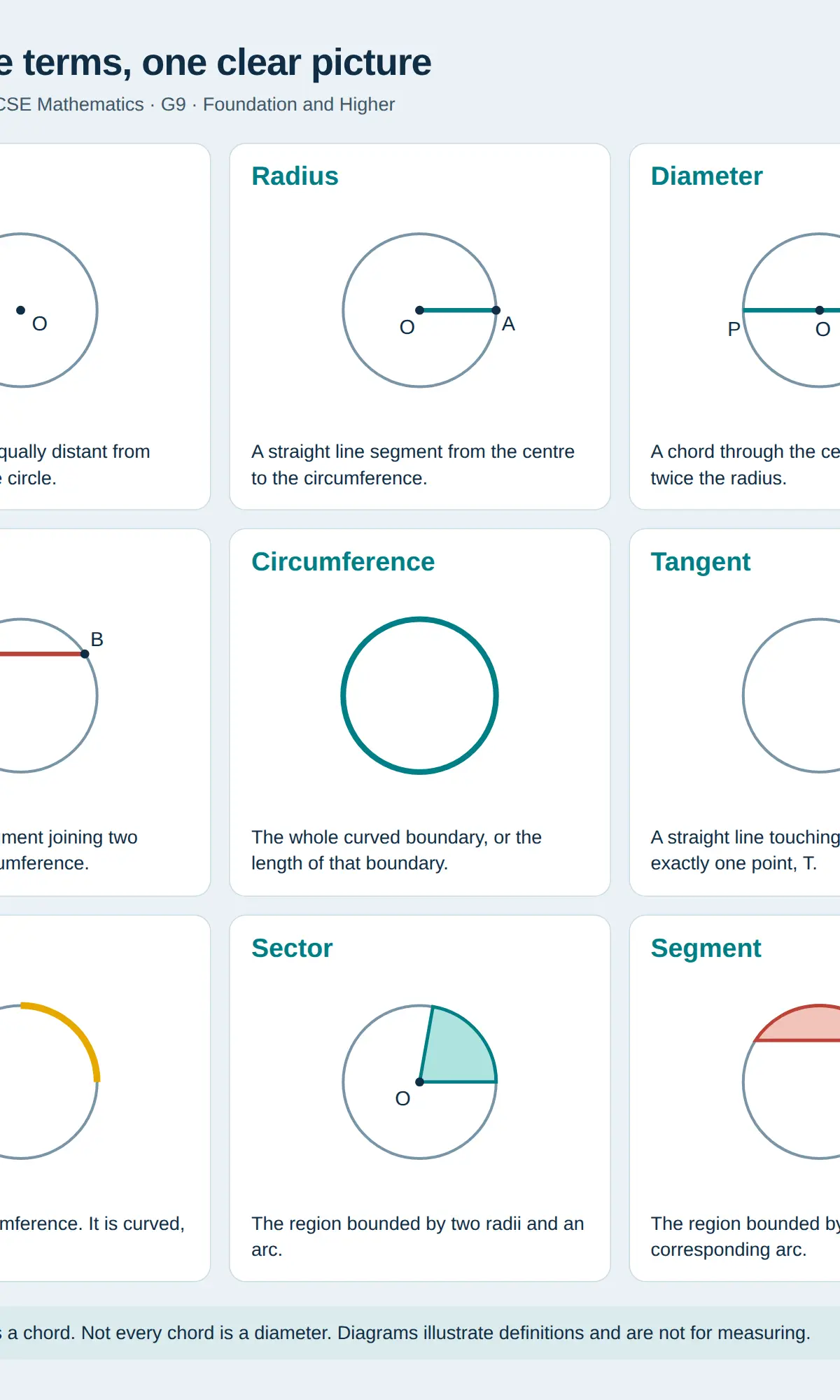
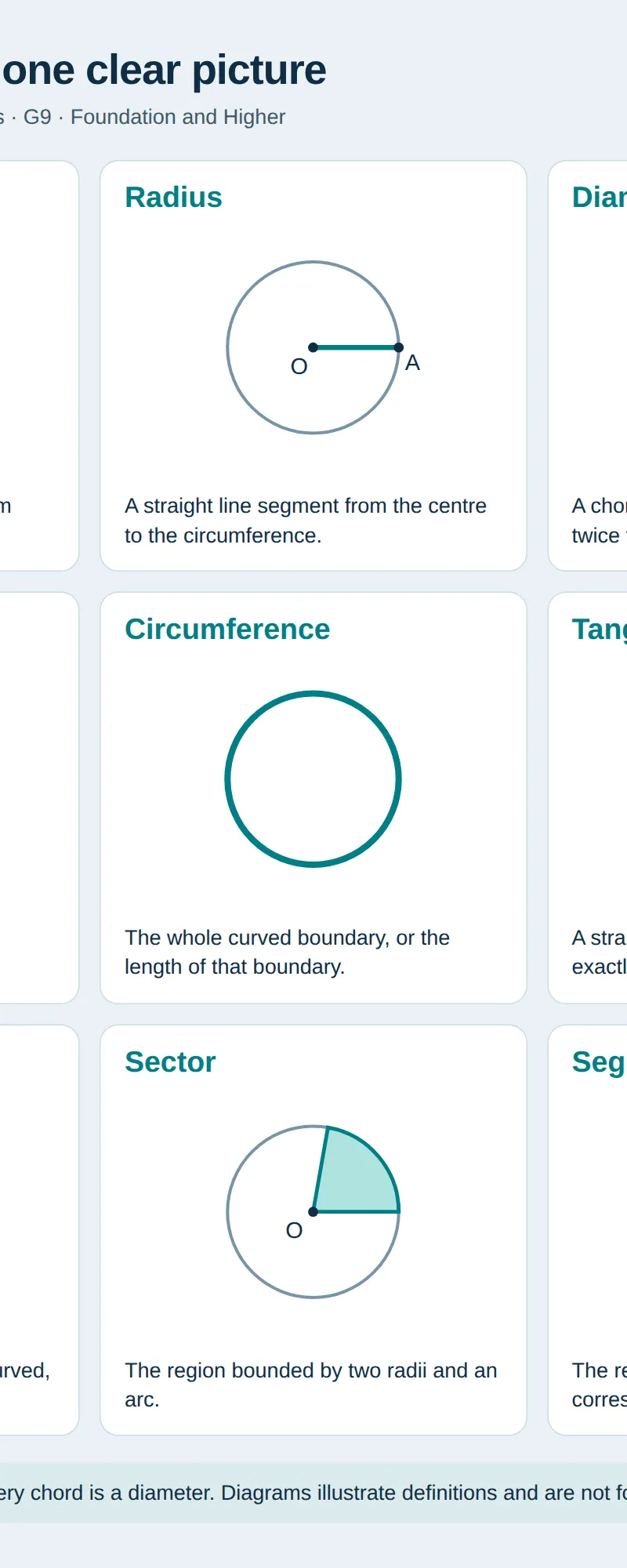
A circle is the set of points in a plane that are all the same distance from one fixed point, the centre. The centre is often labelled O. A radius is a straight line segment from that centre to any point on the circumference; the word also describes its length. All radii of the same circle are equal because equal distance is part of the definition.
Imagine drawing with compasses. The needle stays at the centre while the pencil moves around it. The compass opening is the radius. If the opening changes, the figure is no longer that same circle. A radius need not be horizontal, vertical or drawn on the diagram to exist.
Example: If OA and OB are radii and OA = 5 cm, then OB = 5 cm. No measurement or calculation is needed.
Cover and recall: Why are two radii equal? Give the defining reason, not merely 'they look the same'.
2. Chord and diameter: a special case
A chord is a straight line segment whose endpoints lie on the circumference. A diameter is a chord that passes through the centre. It consists of two radii end to end, so d = 2r and r = d/2. A diameter is the longest possible chord.
Every diameter is a chord, but a chord that misses the centre is not a diameter. Do not confuse a radius with a chord: the centre is not on the circumference. On an unscaled diagram, use the stated centre and relationships rather than judging a line by eye.
Example: A circle has diameter 14 cm. Its radius is 14 ÷ 2 = 7 cm. If another chord is 10 cm long, you cannot assume its radius is 5 cm: that chord has not been identified as a diameter.
Examiner focus: Credit given for a diameter explanation should be supported by 'it joins two points on the circumference and passes through the centre'. Being long, central-looking or horizontal is not enough.
3. Circumference and arc: whole edge or curved part?
The circumference is the entire curved boundary of the circle. The same word is used for the length of that boundary. An arc is a part of the circumference between two points. Both involve curves, but an arc is not a straight chord and neither is an area.
Two distinct points divide the circumference into two arcs. Unless they are opposite ends of a diameter, the shorter is the minor arc and the longer the major arc. Follow the arc identified by the question; 'arc AB' may need a diagram to make the intended route clear.
Example: A full circular track has radius 20 m. One lap is 2π × 20 = 40π m. A quarter-lap is one quarter of that circumference: 10π m. The distance across the track is its diameter, 40 m, not the lap length.
Why does this work? Equal fractions of a circle's full turn correspond to the same fractions of its circumference.
4. Tangent: one point of contact
A tangent is a straight line that touches a circle at exactly one point. That point is the point of contact. A line that crosses the circle at two points is a secant, not a tangent; the part between those points is a chord. A line that misses the circle has no point of contact.
Example: A straight supporting line touching a drawn wheel at just one point represents a tangent. A line passing through the wheel does not. The drawing is a mathematical idealisation, not a claim about the physical contact patch of a tyre.
Higher-only link, G10: A tangent is perpendicular to the radius drawn to the point of contact. In an angle calculation or proof, state the full reason and identify the relevant radius. Knowing the word 'tangent' is both-tier G9 content; applying formal circle theorems is the Higher extension. 1
5. Sector and segment: inspect the straight boundary
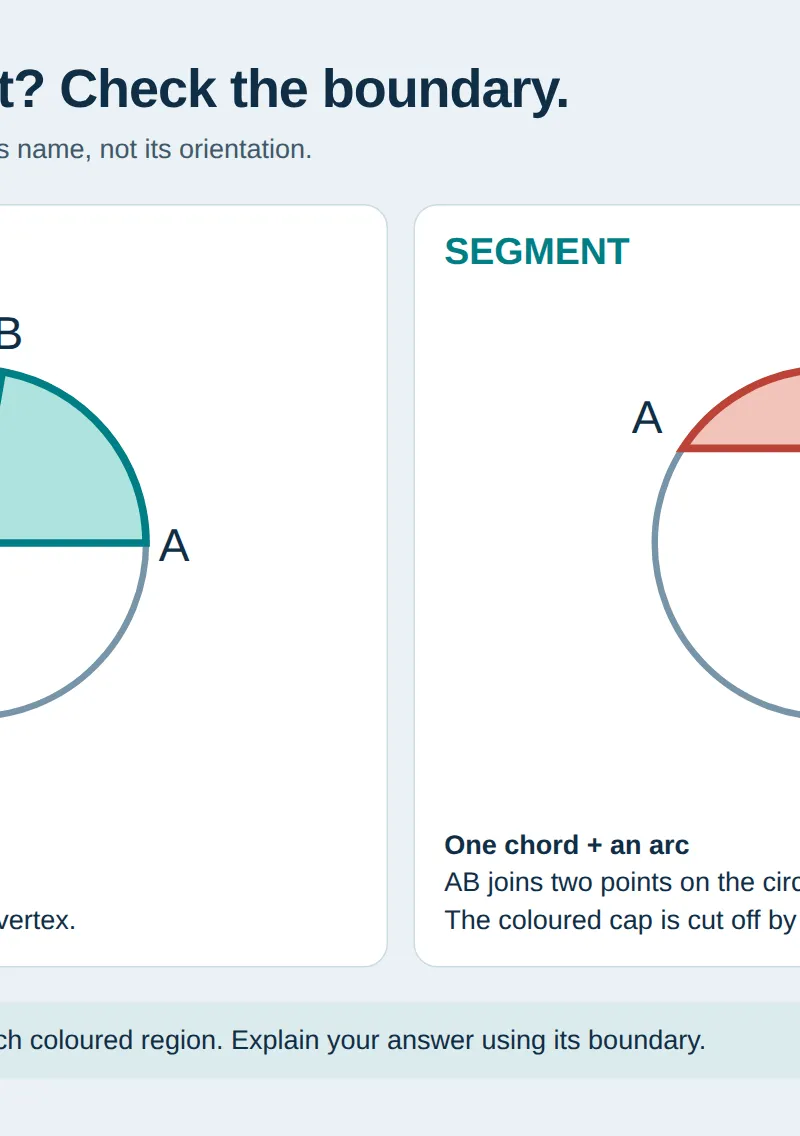
A sector is a region bounded by two radii and an arc. A segment is a region bounded by a chord and its corresponding arc. A sector resembles a pizza slice whose straight sides meet at the centre. A segment resembles a cap cut off by a straight chord. The analogy is a memory aid; the boundary is the mathematical definition.
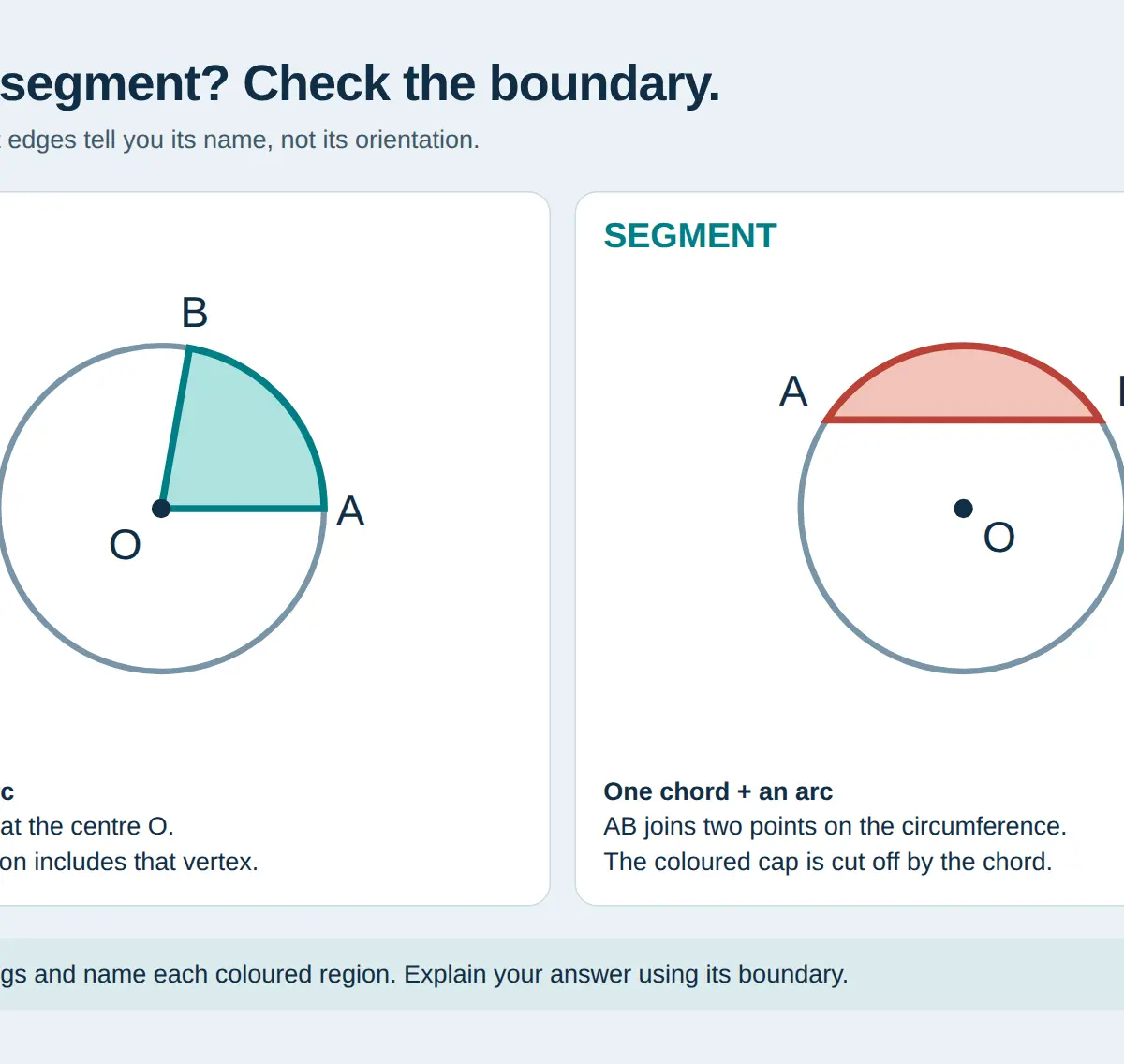
A minor sector has central angle less than 180°; the complementary major sector has angle greater than 180°. A non-diameter chord cuts off a minor and a major segment. Do not choose a name solely from the size or orientation of a shaded region.
Example: Shade the region between OA, OB and the shorter arc AB: this is a sector. Shade the region between chord AB and that arc instead: this is a segment. A semicircle is a special overlap: a diameter cuts off a segment, while two opposite radii form a 180° sector.
Cover and recall: Hide the labels in the comparison image. Name each region and explain your choice using its boundary.
6. Circumference and area: select the quantity first
For a circle, C = 2πr = πd measures the whole boundary length. A = πr² measures the region enclosed by the circle. Here r is radius, d is diameter and π is the constant ratio C/d, approximately 3.14159.
Circumference grows directly with radius because C is a constant multiplied by r. Area involves r² because two-dimensional size grows in two directions. Doubling the radius therefore doubles circumference but quadruples area. This is also a useful error check.
Example: For r = 5 cm, C = 10π cm, approximately 31.4 cm to 1 decimal place. A = 25π cm², approximately 78.5 cm² to 1 decimal place. Do not square π as well: πr² means π × r × r, not (πr)².
A circle of diameter 12 cm has radius 6 cm. Putting 12 in the radius position of 2πr doubles the circumference incorrectly; putting it in πr² quadruples the area incorrectly. Using 12 correctly in πd is valid.
7. Exact answers and sensible rounding
An answer in terms of π keeps π as a symbol, for example 36π cm². This is exact when the given dimensions are exact. A finite decimal such as 113.1 cm² is an approximation. Replacing π with 3.14 is not appropriate when an exact answer is requested.
On calculator papers, retain the π key and unrounded stored values until the final answer. On the non-calculator paper, manipulate the coefficient of π. Use '=' for an exact equality and '≈' for an approximation. If a question specifies decimal places or significant figures, follow that instruction rather than applying a universal rounding rule.
Example: 2π × 4.5 = 9π cm exactly. To 2 decimal places, 9π cm ≈ 28.27 cm. Explain the distinction by saying that π has been retained exactly in the first answer, whereas the second is rounded.
Mathematical Relationships
Formula-sheet status
Pearson's supplied exam aid includes the circle circumference and area formulae. Its 2026 content is unchanged from 2025, and Ofqual has continued formula-sheet provision for the lifetime of the current specifications. Practise with the published sheet for your examination year; a clean copy is supplied, so do not take your own annotated revision sheet into the examination. A supplied formula still requires correct interpretation and application. 2 3 4
Given on formula sheet: C = 2πr = πd; A = πr². Use the first for a whole-circle boundary length and the second for whole-circle area.
Must memorise or be able to derive, not separately printed: d = 2r; r = d/2; C/d = π. Working backwards gives r = C/(2π), d = C/π and r = √(A/π). Take the positive square root because a radius is a length.
Must memorise or be able to derive, G18 application: For central angle θ measured in degrees, let f = θ/360. Arc length L = f × 2πr; sector area S = f × πr²; sector perimeter P = L + 2r for an ordinary sector with two boundary radii. These follow from taking fraction f of a whole circle; they are not separate entries on the cited sheet. G18 is both-tier content, not automatically Higher-only. 1 2
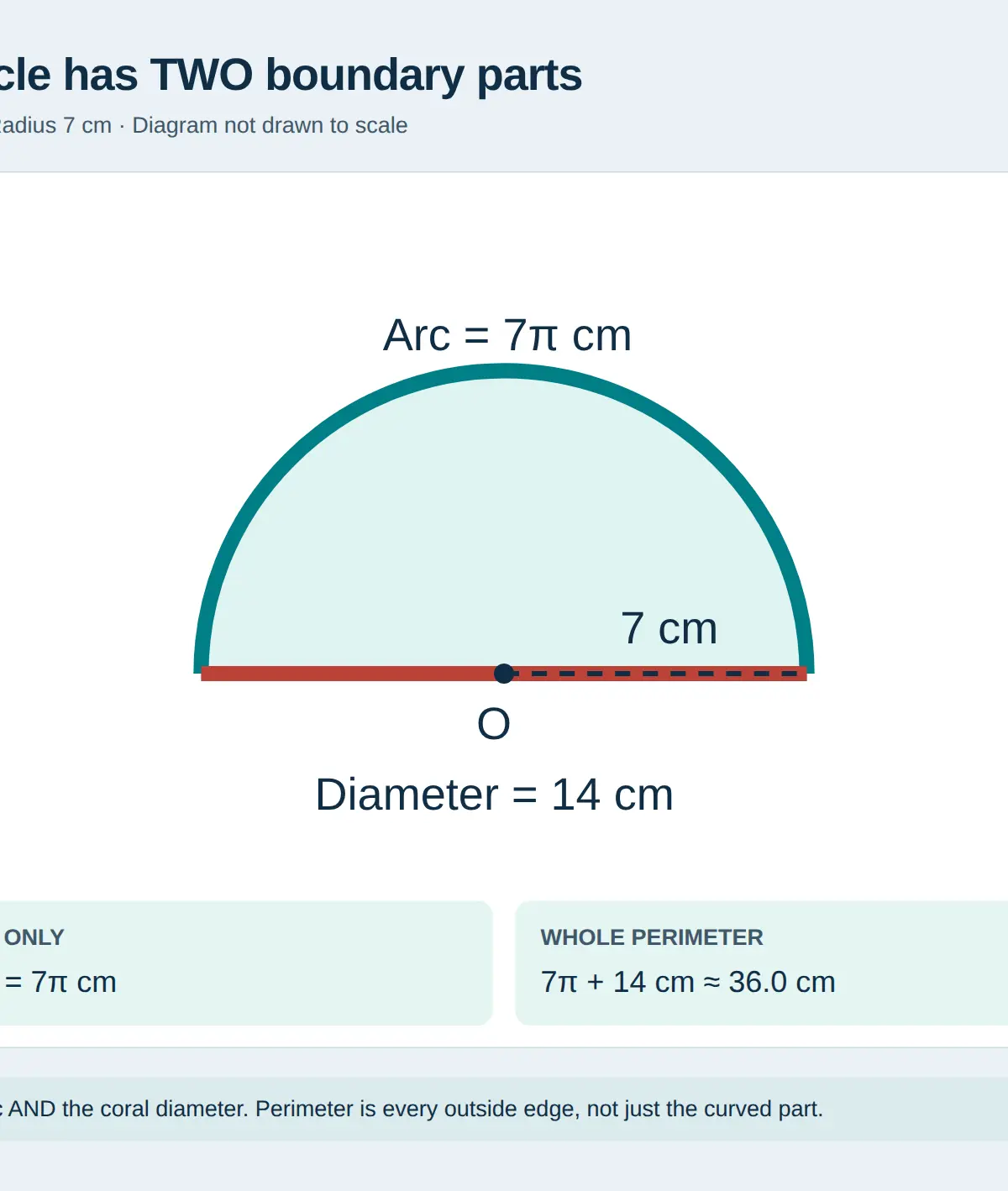
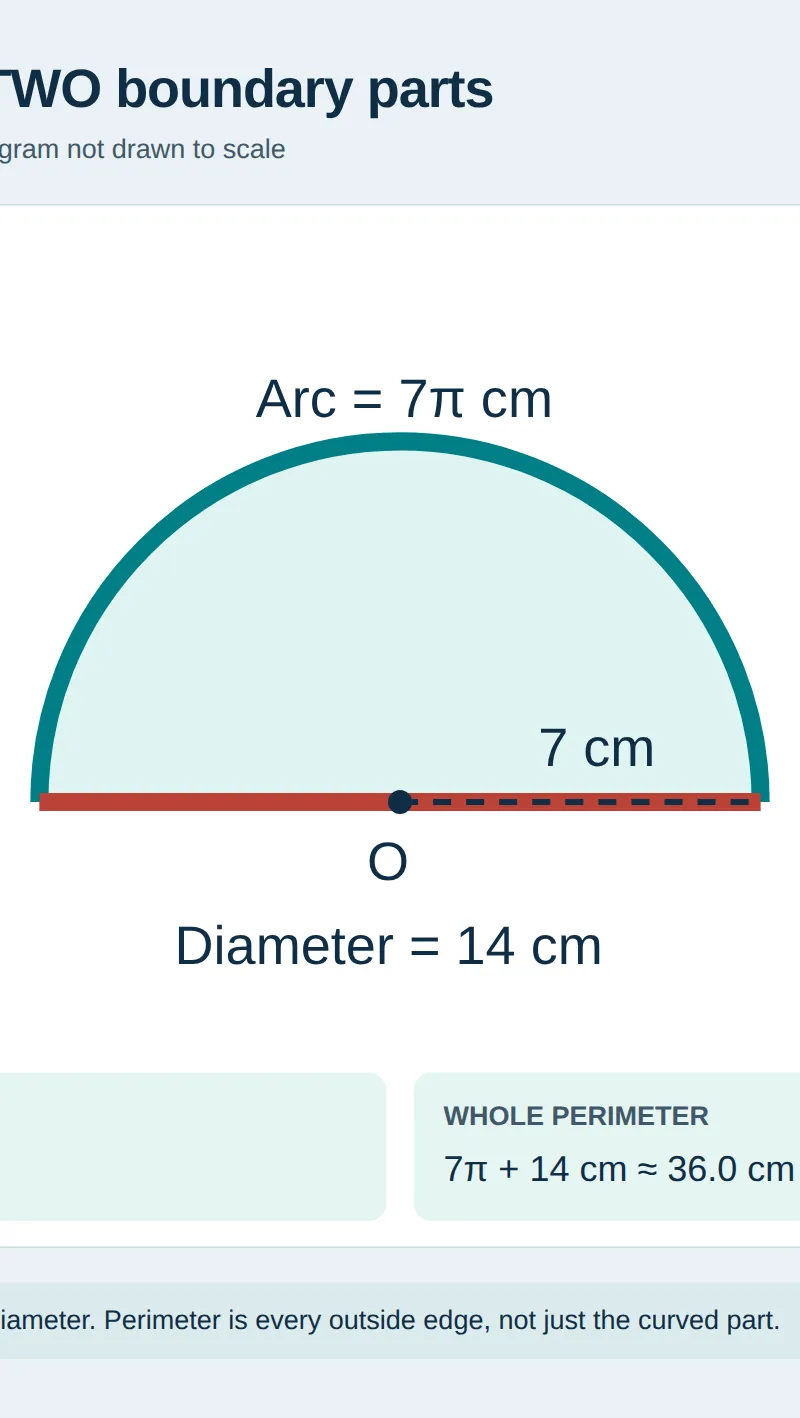
Must memorise or be able to derive, common fractions: Semicircle area = πr²/2; semicircle arc = πr; semicircle perimeter = πr + 2r. Quarter-circle area = πr²/4; quarter-circle arc = πr/2; quarter-circle perimeter = πr/2 + 2r. Area is a fraction of the whole area, but perimeter must include the straight edges.
Units and conversions
Circumference, diameter, radius and arc length use length units such as mm, cm or m. Circle and sector areas use squared units such as mm², cm² or m². Convert all stated lengths to one unit before substituting.
Know that 10 mm = 1 cm and 100 cm = 1 m. For areas, square the conversion factor: 100 mm² = 1 cm² and 10,000 cm² = 1 m². Dividing an area in cm² by 100 does not convert it to m².
Example: Diameter 80 mm = 8 cm, hence r = 4 cm and A = 16π cm². Equivalently, r = 40 mm gives A = 1600π mm². Dividing that area by 100 gives the same 16π cm².
Practical Applications
A circular garden needs edging around its circumference and turf across its area. A wheel's circumference gives idealised distance travelled in one full rotation without slipping. A fan-shaped garden bed is a sector; its border includes the arc and two straight radii. A decorative cap cut off by a chord is a segment, so do not use a sector formula without checking the region.
These contexts may include costs or multiple rotations. First calculate the correct length or area, then multiply by the stated rate. Convert units before applying a cost per metre or per square metre. For fencing a semicircular bed, include the diameter unless the question explicitly excludes that edge.
There is no required practical for this GCSE Mathematics topic. Drawing with compasses and measuring circular objects can support understanding, but they are learning activities, not a required-practical assessment.
Diagram and Data Skills
Read labelled dimensions, centre points and stated relationships. Do not measure an exam diagram unless instructed; it may not be drawn to scale. A straight line joining two boundary points is a chord even when drawn at an unusual angle.
If experimental data plot circumference C vertically against diameter d horizontally, the ideal relationship C = πd is a straight line through the origin with gradient π. Label axes and units, use a consistent scale, and estimate gradient using a large triangle. Such a graph is a link to direct proportion, not a separate requirement of G9. A graph of area against radius is not a straight line because A depends on r².
Turn Understanding into Marks
Read the command word, identify the requested quantity, annotate the radius, write a formula, substitute visibly, and check answer form and units. For a name, use the exact term. For an explanation, give the defining property. For a calculation, a correct substitution can provide evidence for method credit even when arithmetic later goes wrong; the individual scheme decides what is awarded. Pearson uses M for method, A for accuracy, B for unconditional accuracy and C for communication. 5
Each paper is 90 minutes for 80 marks. The overall allowance is 1.125 minutes per mark, approximately 1 minute 8 seconds. Treat 3 marks as roughly 3–4 minutes and 6 marks as roughly 6–7 minutes, with checking time built into your paper plan. These are working targets, not official per-question limits. 1
Listen, Retrieve and Revisit
The ten-minute female-tutor podcast runs through introduction, core concepts, exam traps, a recall quiz and a summary. Answer before the narrator does. After listening, close the guide and draw a circle showing all nine terms, using separate sketches where necessary to avoid clutter. Redo one calculation tomorrow and again later in the week without notes. Check errors afterwards rather than rereading first: the retrieval attempt shows what you can actually recall.
References
Visual Resources
3 diagrams and illustrations
Interactive Diagrams
2 interactive diagrams to visualise key concepts
Conceptual Flow Outline
Classify each named part by whether it is a point, straight line or segment, curved boundary, or region.
Conceptual Flow Outline
Choose a circle calculation from the requested quantity, then check units and answer form. Sector angles are measured in degrees.
Worked Examples
4 worked examples — open one to explore the question and available guidance.
Practice Questions
Try the question, then reveal an answer plan or example response
Give the name of (a) the whole curved boundary, (b) part of that curved boundary, (c) a region bounded by two radii and an arc, and (d) a region bounded by a chord and an arc. (4 marks)
Hint: Separate curved lines from regions, then inspect the straight boundaries.
A circle has diameter 18 cm. Calculate its circumference in terms of pi, then give it correct to 1 decimal place. (3 marks)
Hint: Use the formula written directly in terms of diameter.
A circle has radius 3.5 cm. Calculate its area in terms of pi. (3 marks)
Hint: Square 3.5 before multiplying by pi.
A semicircular garden has diameter 20 m. Work out the complete perimeter in terms of pi. (3 marks)
Hint: Trace the outside edge and include the straight side.
A sector has radius 6 cm and central angle 120°. Calculate its arc length and area, giving both answers in terms of pi. (4 marks)
Hint: 120° is what fraction of 360°?
A circle has circumference 18π cm. Calculate its radius and then its area in terms of pi. (4 marks)
Hint: Set 2πr equal to the given circumference before dividing.
A circular badge has diameter 60 mm. Calculate its circumference in cm and its area in cm². Give exact answers in terms of pi. (4 marks)
Hint: Convert the diameter first, then halve it for the area calculation.
Exam technique
How to turn what you know into marks
How to approach the question
Read the command word and requested quantity. Mark the centre and radius; halve a given diameter where necessary. Decide whether the answer is a name, length, area or complete perimeter. Write the formula, substitute visibly, and check units and answer form. Use stated dimensions rather than measuring an unscaled diagram.
How to structure your answer
For a 1-mark name, give the precise term. For a 2–3-mark calculation, show a correct formula with numerical substitution, the calculation and the final answer. For a 4–6-mark multi-part problem, label each part and show boundary additions or fraction-of-circle reasoning. Do not assume every line automatically earns a separate mark. The suggested schemes here use Pearson-style M, A, B and C conventions, but the official question-specific scheme controls actual credit.
Timing
Each 1MA1 paper has 80 marks in 90 minutes: 1.125 minutes per mark overall, approximately 1 minute 8 seconds. Aim for about 3–4 minutes for 3 marks and 6–7 minutes for 6 marks, while reserving checking time. These are guide targets, not official question time limits.
Common pitfalls
- Using d as r in 2πr doubles the circumference; using d correctly in πd is valid. Write r = d/2 before calculating area.
- Confusing sector and segment: check whether the straight boundary is two radii or one chord.
- Finding only an arc when a perimeter is required: trace and add all outside straight edges.
- Squaring π along with r: πr² means π × r × r.
- Replacing π with 3.14 early: keep π exact or use the calculator π key, then round once.
- Treating area-unit conversions like length conversions: square the conversion factor.
- Assuming units or follow-through always carry a separate mark: read the question and individual scheme.
What the command words want
- Compare
- Use the requested comparison, such as greater than, a difference or a ratio. Make the basis of comparison explicit.
- Explain
- Give a mathematical reason: for example, AB is a diameter because it is a chord through the centre.
- Describe
- Specify the relevant geometric features, such as endpoints, centre and boundary. Avoid vague appearance-based descriptions.
- Evaluate
- If an expression is supplied, calculate its value. If a claim is being assessed, test it mathematically and conclude; an essay weighing both sides is not the default maths response.
- Work out
- Perform the calculation with clear working. This is common mathematical wording, not permission to give an unsupported guess.
- Calculate
- Show a suitable formula and numerical substitution, then the final value with appropriate units and requested precision.
- Show that
- Demonstrate the steps leading to the stated result. Merely copying the given result does not establish it.
- State/Give
- Give the requested fact or most specific mathematical name. A one-word answer may be sufficient for a name.
- Write down/Name
- Identify the labelled object directly. Do not calculate or measure when a definition answers the question.
Watch or listen (optional)
Test your understanding of Geometry and measures - Properties and constructions: identify and apply circle definitions and properties, including: centre, radius, chord, diameter, circumference, tangent, arc, sector and segment
Active recall beats re-reading. Take an instant quiz now to test what you’ve learned and lock it into long-term memory.
7 days Premium · Then the free plan continues · No card, no charge